Rainy weather in Västerås
A Sunday that chose the rain for us
Breakfast was eaten, but neither of us was exactly keen on going out into the rain.
The sky hung low and grey over the rooftops, and those are the mornings when the sofa tempts more than the boots.
Still, we made a trip down to Elbakajen.
It became a short walk, because the weather made it easy to give up, and soon we drove home and had something nice to eat instead.
There is no shame in that.
Sometimes the wisest thing you can do is to let the day win.
Leica Camera News
Mari Amman is an American-Italian contemporary artist who works across disciplines with photography, installations, video, poetry, painting, sculpture, textiles and design.
She herself describes her work as research-based and uses concepts such as Geological Empathy and Sublime Rheology to explore the relationship between people, nature, technology and built environments.
Young, Inspiring and International: LOBA Emerging Talent
Furthermore, the German photographer Serghei Duve won the Newcomer award 2025 with the photo series “Bright Memory”.
In the project he explores his family’s connection to Transnistria.
Discover Serghei Duve’s work →
Stephen Song
Stephen Song – the street photographer who captures the human theatre
There are photographers who search for the perfect subject, and then there are photographers who let themselves be surprised by what happens right in front of them.
Stephen Song belongs, at least judging by his published pictures and his own words, to the latter category.
Song is a photographer whose work has been featured in Leica Fotografie International (LFI), where he has an extensive portfolio of street photography from Paris, among other places.
His pictures have repeatedly been selected for the LFI picture galleries, Selections and Mastershots.
What makes his photography interesting is the attention to people’s expressions, body language and encounters in public space.
The street becomes not only a place where people pass by, but a stage where identities, emotions and social roles become visible for a moment.
In a presentation at LFI, published in September 2025 under the heading U Got the Look, Song talks about a picture from Paris showing two young people with a strong and defiant appearance.
He describes how their expression stirred both admiration and melancholy in him.
Behind the outward self-confidence he also senses vulnerability and a search for identity and belonging.
It is an interesting starting point for his street photography: reality can sometimes seem to stage itself.
The photographer’s task then becomes to be attentive enough to see the moment when everything comes together – the people, the glances, the surroundings and the mood.
Song himself refers to the Swedish photographer Anders Petersen and his classic visual world in Café Lehmitz.
The reference suggests an interest in a direct and human photography, where people are allowed to appear with their own character and where the imperfect, intense and contradictory are given room.
In his later LFI publications from Paris, street photography recurs as his form of expression.
He uses, among other things, the Leica M11 Monochrom and a 24 mm lens – a combination well suited to close and engaged work in the urban environment.
Who Stephen Song is outside of photography, however, is harder to establish from the public sources I have found.
I have not been able to verify any reliable, detailed biography of his background, education or professional life.
That is why his pictures and his own reflections are put at the centre.
That goes a long way.
In street photography, after all, it is the photographer’s eye that tells the most.
Steve Ney
# Steve Ney – between fashion, identity and photography
**When fashion photography becomes a way of telling about people**
Steve Ney is a French photographer with Indian roots, born in Paris in 1997.
He belongs to a younger generation of photographers who move freely between the fashion world and documentary storytelling.
In his work, staging, personal searching and an interest in people whose lives and identities do not always get the attention they deserve come together.
Photography came into his life early through his mother.
Together with his interest in fashion, it has become the foundation of his artistic expression.
Through social media his work gained attention, which helped him establish himself in commercial photography and fashion photography.
In 2025 he was awarded the Filippo Roversi Endowment, a recognition which, according to Leica Fotografie International, also highlights his artistic vision.
## India – a personal return
An important part of Ney’s photographic work is about India, the country in which his family history is rooted.
His project is not only about documenting an unfamiliar environment, but also about approaching his own origins and exploring the bonds that unite people, places and memories.
In the project *Les Divines* he returned to Pondicherry, where over several days he photographed trans women from the local community.
He came into contact with the women through the organisation Sahodaran.
The project has a special personal significance.
Ney says that his father, who was an orphan, grew up in the same neighbourhood before he emigrated to France.
When the photographer himself was there, he therefore experienced a strange feeling of coming home, even though the place was also new to him.
The personal encounter between family history and photography gives the project a dimension that goes beyond traditional fashion photography.
## Making the invisible visible
In *Les Divines* Ney combines the visual power of the fashion image with documentary photography’s interest in real people and living conditions.
One of the pictures shows a model dressed in red, wearing a Balenciaga jacket, against a worn facade and a rusty gate.
The contrast between the exclusive garment and the raw environment creates a tension between the surface of the fashion world and the reality that surrounds the person.
The colour red has a central meaning in the visual language.
Ney associates it with sensuality, strength and self-confidence.
At the same time, hidden faces are used to portray the feeling of being invisible, despite being in the midst of other people.
It is a visual idea that raises questions about visibility, representation and the right to define one’s own identity.
Ney has described fashion and photography as universal languages, capable of conveying emotions and meanings without everything having to be explained in words.
He wants to create pictures that provoke an immediate reaction, but at the same time leave room for the viewer to interpret their meaning themselves.
## Between staging and reality
What makes Steve Ney interesting is that he does not seem to regard fashion photography and documentary photography as opposites.
Instead, he uses the possibilities of the one form to deepen the other.
The colours, clothes and visual compositions of fashion photography become tools for approaching questions of belonging and human dignity.
At the same time, the documentary elements are given an aesthetic form that makes the pictures immediately expressive.
This does not mean that the photographs need to explain the whole reality they portray.
Rather, they open a space for the viewer to pause, see and reflect.
Steve Ney’s work shows how photography can be both a visual art form and a personal way of examining the world.
Behind the carefully crafted fashion image there is a desire to meet people and give room to experiences that otherwise risk ending up outside the frame.
**Sources and further reading**
– [Steve Ney – LFI Gallery](https://lfi-online.de/en/gallery/Steve-Ney-813504.html)
– [Steve Ney – On the cover photo, Leica Fotografie International](https://lfi-online.de/en/stories/steve-ney-on-the-cover-photo-22120.html)
– [Les Divines – interview with Steve Ney at Leica Camera France](https://leica-camera.com/fr-FR/blog/photographie/steve-ney-les-divines-sl-m-systeme)

📷 iPhone15,4 · iPhone 15 back camera 5.96mm f/1.6 · f/1.6 · 1/400s · ISO 50 · 5.96mm · 2026-10-11
Rainy weather in Västerås
Where the water and the sky became the same colour
Before we turned for home, I still managed to take a few pictures, partly with the Leica M11 Safari, partly with the new Hubbo Foto app.
Lake Mälaren lay smooth and still, and the sky pressed down towards the water until you could hardly see where one ended and the other began.
Out on the pier stood the little lighthouse in white and red, and past it glided the Sea Rescue boat with a white wake behind it.
It was like watching someone go to work while the rest of the town was still asleep.
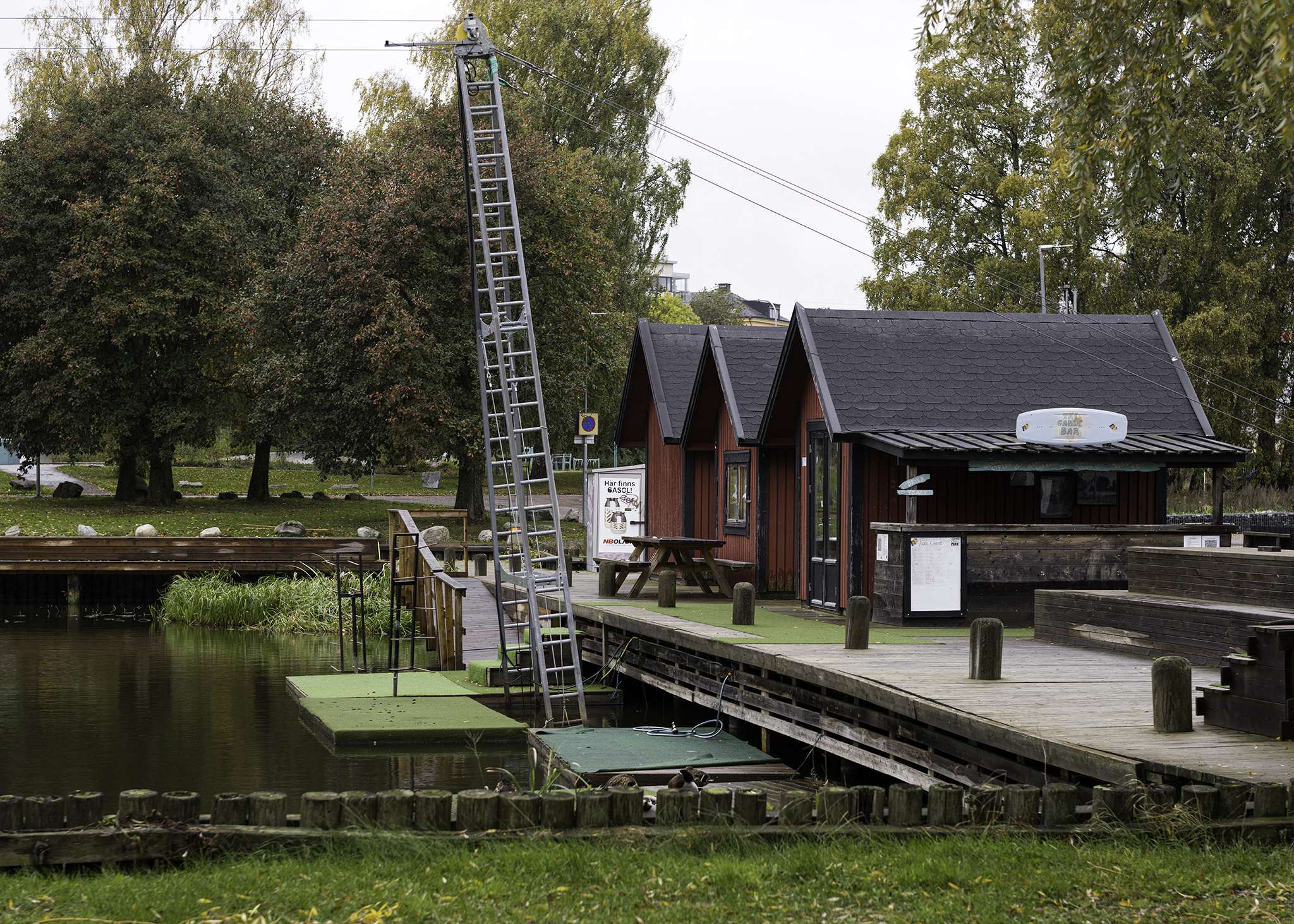
At the wakeboard park everything was empty.
The season is over, the jetties are still there but nobody rides there anymore.
Further away, Magasinet rested under the clouds, and a heavy anchor chain lay over the edge of the quay and disappeared into the water, as if it were holding on to autumn itself.
Rainy weather in Västerås
The app that is slowly becoming mine
There have been no updates to Hubbo Foto today, and no testers have been in touch about things that feel wrong or that they would like changed.
So I plan to take a whole day and photograph only with Hubbo Foto, to test it more in daylight and also in evening light.
So far I think it is great fun to photograph with, and I will probably like it even more once I have got a feel for all the menus I have built.
Rainy weather in Västerås
An attempt to let go of Adobe
Alongside that, today I have got a bit further with two new programs.
The idea is that they should be able to replace the programs I use from Adobe, which cost a bit unnecessarily much.
PhotoCraft has Spot Healing Brush, Healing Brush, Patch and Content-Aware Move, that is, the same classic tools that Photoshop had before Generative Fill.
With them you remove sensor spots, wires and smaller distracting things.
LightCraft has Remove, Heal and Clone for spots.
A content-aware removal tool (content-aware fill) is something they are working on right now.
📷 LEICA M11-P · Summilux-M 1:1.4/50 ASPH. · f/3.4 · 1/180s · ISO 125 · 50mm · 2026-10-11
Two days of photography
Rainy weather in Västerås
To get the two programs to work together, I have built the tool Hubbo Bildbrygga.
It consists of three small programs:
Starta LightCraft starts LightCraft with the control channel switched on.
I use it instead of the usual icon.
Skicka till PhotoCraft turns the pictures I have selected in LightCraft into 16-bit TIFF copies, stacked with the originals, and opens them all in PhotoCraft.
PhotoCraft is started by the tool itself.
Hämta tillbaka saves all the pictures in PhotoCraft with the layers intact and closes them there.
Then I get to choose Bredvid originalen or Välj mapp…, and the pictures are read into LightCraft again.
Two hundred years of light
Rainy weather in Västerås
Finally, a tip about a photo project worth following: fotografering.nu
A personal project about an inexhaustible medium.
In 2026, photography turns 200 years old.
Not officially, not exactly, but close enough to be a reason to pause and consider what has happened since Niépce for the first time managed to capture a photograph that did not fade.
This is my way of celebrating it.
A hundred glimpses into the history of photography, from Niépce’s pewter plate to the image world of algorithms.
A hundred Swedish photographers who have shaped a domestic tradition that deserves to be highlighted.
And a personal attempt to answer the question all photographers ask themselves: what is worth preserving?
Thank you Niklas for the tip.
I will read through it, so that I am up to speed with your work later on.
Perhaps that is exactly what a grey Sunday teaches us: that even the days that do not turn out the way we imagined are worth preserving.

Pictures from today’s adventure


